Noryangjin Fish Market: Ordering Steps & Separate Restaurant Fees
At Noryangjin Fish Market, agree on two bills before you buy dinner: the seafood seller’s price and the restaurant’s charges for serving or cooking it. A fish or crab price at a tank is not automatically the price of a finished meal. The useful first question is therefore not just “How much per kilogram?” but “What will our whole order cost, including the restaurant?”
This guide is for a first visit to the modern market at 674 Nodeul-ro, Dongjak-gu, Seoul. It explains how to get there, choose an order, and keep the stall-to-restaurant handoff clear. The advice below draws on current information from the market operator and Seoul’s official tourism site. Information checked October 30, 2026. Seafood prices and individual restaurant charges must be confirmed on the day.
Quick plan: get there, look around, then order
- Subway: Noryangjin Station, served by Lines 1 and 9. Use the Exit 9 approach described below.
- Start: the first-floor seafood sales area, unless you have arranged a particular restaurant first.
- Eating: the operator lists sashimi restaurants on the second and fifth floors. Get the exact restaurant name and floor; “upstairs” is not enough.
- Timing: choose lunch or dinner for a meal. Overnight auctions are a different activity, and a 24-hour market listing does not promise that every restaurant is open.
- Budget: reserve money for both businesses. There is no single verified market-wide dinner price or restaurant tariff.
Find the modern market from Noryangjin Station
Save 노량진수산물도매시장 in your map app, together with 서울 동작구 노들로 674. This is the wholesale fish market, not simply the Noryangjin neighborhood.
The market operator’s directions give a straightforward Line 1 route: leave through Exit 9 and continue straight about 150 meters to the market entrance. Visit Seoul also recommends Exit 9 for Noryangjin Station. If arriving on Line 9, follow station signs toward that exit and allow time to walk through the station. Check your map before leaving the station and follow current market signs.
The map pin on this article marks the market as a whole, not a particular door, stall, restaurant or step-free entrance. For elevators or a step-free approach, check current station signage and ask staff; this guide has not verified an uninterrupted accessible route. Our Seoul subway guide covers the ticket and transfer basics.

How to order, without losing track of the bill
1. Decide what you want to eat before discussing weight
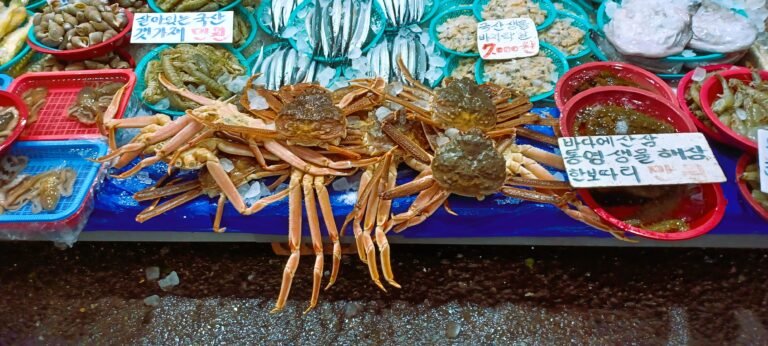
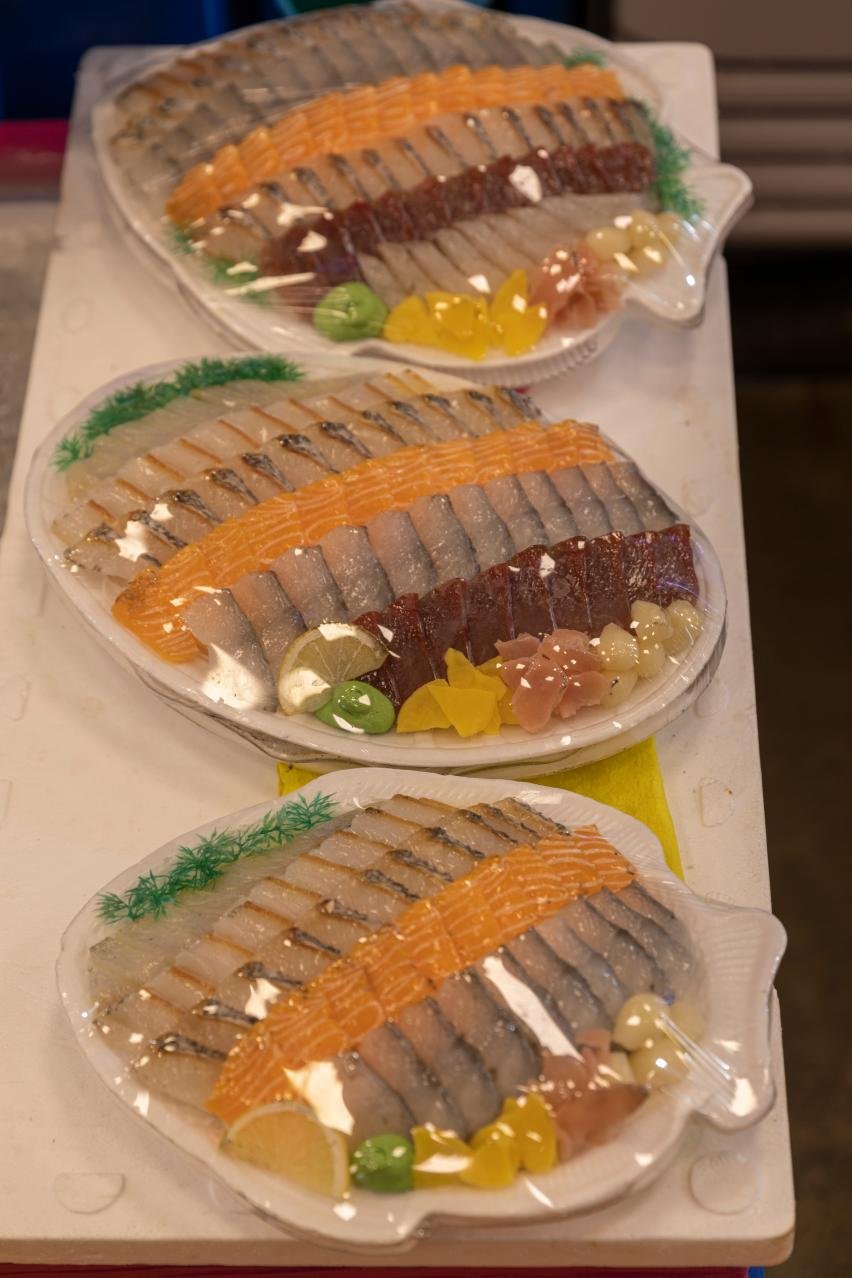
Tell the seller how many people are eating and whether you want sliced raw fish (hoe), a cooked seafood meal, or takeaway. These are different orders. For a fixed-price platter, ask which seafood and portion are included. For a whole fish or crab, ask whether the quote is per kilogram, per animal or a total.
For two people or a solo visit, start with a modest order and ask whether a smaller platter is available. Do not assume you need a whole crab to experience the market. If you want cooked food only, settle that before buying: the restaurant needs to confirm it can prepare your choice the way you want.
2. Get the stall’s total, not just a unit price
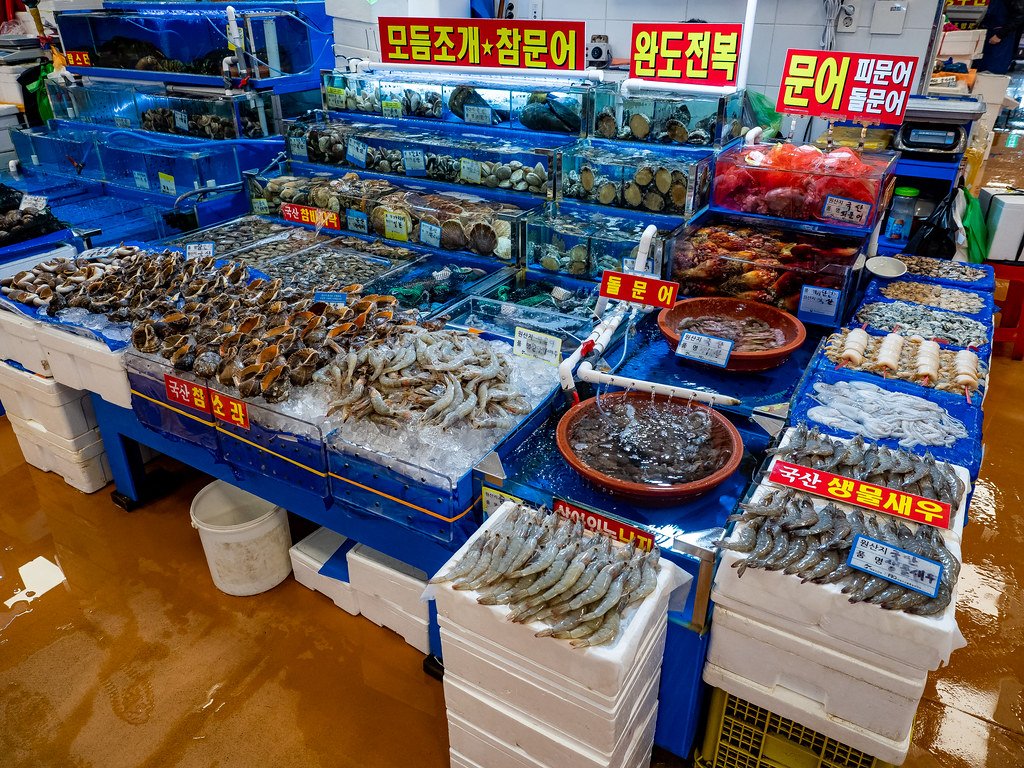
Point to the exact seafood you are buying. Confirm the chargeable weight, unit price and final seafood total before it is prepared. Ask whether slicing, cleaning, packing or another requested service is included. If a seller adds a complimentary item, check whether you actually want it and whether cooking it would add a charge at the restaurant.
Compare like with like: the same species, size or grade, quantity and preparation. A low figure for one kilogram is not a useful comparison with a fixed platter or a different-sized crab. You can decline an unclear quote and keep looking.
3. Confirm the restaurant separately, before committing
Ask the restaurant, directly or with the seller’s help, for the following:
- Can it seat your group now, and does it accept the seafood you plan to buy?
- What is the table-setting or accompaniment charge, and is it per person?
- What does the requested cooking cost: per kilogram, per item or per dish?
- Are soup, rice, sauces, side dishes and drinks included or extra?
- Will anything change if you skip the fish stew or choose takeaway?
A seller’s suggested restaurant is a starting point, not a reason to skip these questions. If you have a specific restaurant in mind, confirm its hours, availability and arrangement first. Do not buy seafood assuming any restaurant will accept it or have a free table.
4. Keep the handoff specific
Before paying the seller, note the stall name or number, seafood and agreed total. Obtain a receipt. Confirm who will carry or deliver the order, the restaurant’s name and floor, and how staff will identify your party. Keep that information until the meal and both bills are settled.
Visit Seoul describes the usual arrangement as paying the fishmonger for the seafood and the restaurant separately for accompaniments. Who slices or cooks a particular order can vary, so ask who is handling each job rather than paying twice for an assumed service.
A simple budget check to use on your phone
Write the quotes as separate lines before agreeing to the meal:
- Seafood and any stall preparation: ₩_____ total
- Restaurant table charge: ₩_____ × _____ diners
- Cooking: ₩_____ × the agreed kilograms/items/dishes, or ₩_____ flat
- Extras you actually want: soup ₩_____; rice ₩_____; drinks ₩_____
- Combined meal total: ₩_____
Add each charge only once. If a quotation already includes cooking or accompaniments, mark it as included. Ask both businesses how you can pay before ordering; this guide does not promise foreign-card acceptance at every counter.
The operator publishes daily auction prices in Korean. They can help you understand price trends, but they are not a retail menu or an all-in restaurant quote. Check the species, date and unit: the table includes different packaging and quantity units. Do not multiply an auction figure by your dinner weight and expect that to be the final bill.
Useful phrases to show staff
- 이거 총 얼마예요?
How much is this in total? - 킬로그램당 가격이에요?
Is that the price per kilogram? - 상차림비는 1인당 얼마예요?
How much is the table-setting charge per person? - 조리비는 별도예요?
Is the cooking charge separate? - 모두 익혀 주세요.
Please cook everything fully. - 식당 이름과 층을 알려 주세요.
Please tell me the restaurant’s name and floor.
Show the questions one at a time and ask staff to write the amounts. A translation app can help with the specific seafood and cooking method; a photograph of a different dish is not a confirmed order.
When to go: retail hours are not auction hours
The operator’s current schedule lists wholesale and retail sales as year-round, with its “high-class” section open 24 hours. It lists general seafood from 1:30 a.m. to 10 p.m., frozen seafood from 3:30 a.m. to 10 p.m., and shellfish from 1 a.m. to 10 p.m. These are section hours, not a guarantee for an individual stall or dining room.
Auctions have a separate overnight schedule and Sunday and holiday closures. For an ordinary seafood lunch or dinner, there is no need to arrive for an auction. Check your chosen restaurant’s service hours and last order separately, especially before an early or late visit. Do not interpret “open 24 hours” as “dinner available all night.”
Is this the right meal for your trip?
Choose Noryangjin if you enjoy looking at seafood and are comfortable comparing an itemized order. The buying process is part of the experience. Choose a restaurant with a clearly priced menu instead if your priority is a predictable bill, a quick solo meal or minimal discussion. A wholesale-market visit does not guarantee the cheapest seafood dinner.
You can also look around without turning the visit into a large purchase. Keep aisles clear, watch for wet floors, and ask before taking close photographs of a stall or its workers. The official floor guide helps distinguish sales areas from restaurants. For a simpler food outing, see our Mangwon Market snack walk; for a clearly priced noodle meal in the center, see the Myeongdong Kyoja ordering guide.
Sources and photo notes
Operational facts were checked against the market operator’s directions, floor guide, opening schedule and auction-price page linked above, plus Visit Seoul’s market listing (edited May 5, 2026). Restaurant acceptance, preparation charges and availability remain business-specific. The photographs are archival reference images, with capture dates given where known, not evidence of today’s prices, stall tenants or opening status.